South Vietnamese Special Branch
The SympathizerThe South Vietnamese Special Branch is the secret-police organization through which the unnamed narrator serves The General, and its central contradiction is that an institution built to watch others is itself watched. Its officers pursue spies and protect the regime, yet the evidence they collect cannot reliably distinguish a genuine threat from a convenient scapegoat. The branch’s compromised intelligence network becomes a measure of the narrator’s divided loyalties and of the instability surrounding the government it serves.
Institutional Position and Personnel
The narrator’s career places him within the security apparatus before his exile. He first serves The General in the Army of the Republic of Vietnam; when The General takes charge of the National Police of the Republic of Vietnam, the narrator moves with him and becomes involved with the South Vietnamese Special Branch. On his return to college in the United States, he conceals this service from a student journalist, describing himself instead as a quartermaster who tracked supplies and never killed anyone. He considers acknowledgment of infantry service, combat, and Special Branch work politically delicate on an American campus shaped by antiwar activism.
The branch’s institutional identity is bound to The General’s authority. In the refugee period, The General remains preoccupied with reports and meetings even as he weighs how to hold the capital while preparing to abandon it. The narrator’s proximity to him is both professional and dangerous: he is trusted with consequential work, but must constantly manage what his superior can infer about him.
Surveillance and the Captured Agent
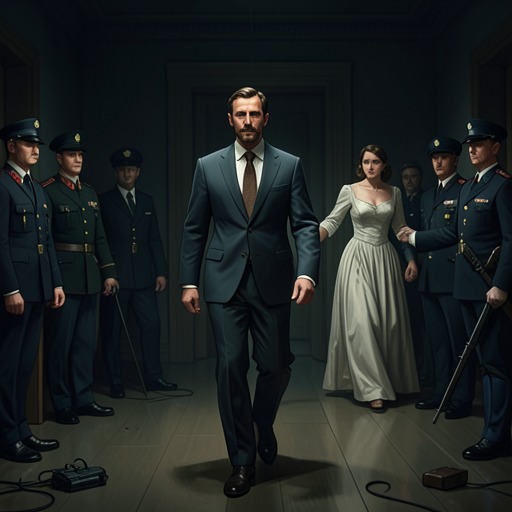
The branch’s vulnerability is made concrete when its officers break into a room to arrest The Communist Agent. The narrator had warned Man about her, but the warning did not reach her in time. During the arrest, he retrieves a concealed list bearing the names of the branch’s personnel, from junior officers to The General. The document exposes the reach of an opposing intelligence network and reverses the presumed direction of surveillance: the watchers have been watched.
The narrator cannot tell the arrested woman that he is on her side without exposing his own cover. He believes she would disclose his secret under interrogation, even unwillingly, and recognizes that she sees him as an agent of the regime. Her appeal to innocence does not change the outcome. Three years later, she remains in a cell; the narrator keeps her file on his desk, with a photograph from her arrest and a more recent image showing the effects of her prolonged confinement. Man shares responsibility for failing to protect her and says he will be the one to unlock her cell when liberation comes. Her case stays with the narrator as he prepares an evacuation list, making each name he removes feel like a sentence passed on someone else.
Suspicion and Counterintelligence Failure
The branch’s search for an infiltrator shows how quickly suspicion can outrun evidence. When The General asks whether a spy might be among his own men, the narrator understands that denying the possibility could itself make him appear suspicious. He therefore names The crapulent major, not because he has evidence against him, but because he expects the suggestion to distract The General. It works: The General dismisses the suspect and turns his attention away from the narrator.
Later, when The General, Claude, and the narrator discuss an informer, The General again names The crapulent major. His reasons include the major’s Chinese background, his family’s apparent prosperity in Saigon, and The General’s personal dislike of fat men. Claude says he does not know the major, while the narrator challenges the assumption that Chinese identity makes someone a spy. The General denies being racist and presents the family’s prosperity as suspicious because he believes Communist contacts would otherwise prevent officers’ families from doing well. The evidence offered is circumstantial and shaped by prejudice, yet it is treated as a basis for suspicion. The narrator’s earlier attempt to redirect The General’s attention thus becomes an unintended contribution to a later accusation.
The same pattern appears in exile. After Sonny publishes information about the Fraternity’s possible armed activity and alleged financial interests, The General concludes that someone is leaking reliable information. The narrator explains how a reporter might gather fragments from many people, while The General interprets the article as dangerous propaganda that could mislead refugees about the prospect of returning home. The episode extends the branch’s old problem into a new setting: information circulates beyond the institution’s control, and the search for a source risks becoming an exercise in suspicion rather than verification.
Interrogation and the Work of Representation
The novel also places the branch’s world beside the professional knowledge of interrogation. Claude’s course presents historical and photographic images to make an argument about violence and shared human capacity. In a separate film-set sequence, Vietnamese refugees and former fighters perform the roles of Viet Cong interrogators, while the production stages the questioning of Binh. The unnamed narrator distinguishes the performance from the actual experience of water torture, noting that the stunt performer’s breathing was protected by a tube. The scene does not establish that every method shown was used by the South Vietnamese Special Branch; instead, it reveals how interrogation expertise and its representation overlap in the narrator’s professional world.
That overlap matters because the branch depends on people who observe, interpret, and report, while its own personnel remain exposed to competing watchers and to the stories told about them. Its records can preserve a captive woman’s decline, but they cannot restore her freedom; its counterintelligence judgments can identify real vulnerabilities, but they can also convert ethnicity, wealth, and personal animus into supposed evidence. The institution’s defining failure is therefore not simply that it is penetrated. It is that surveillance does not guarantee knowledge, and the power to classify others can conceal how uncertain the classifier’s own position has become.